How exciting... We have a bee obsession this month!
Next up in our bee posts? Weird but true facts!
1. Male bees only live to mate with the queen bee. If there is a lack of food, the female worker bees kick out the male bees!
2. When the males mate with the queen they die afterwards. Their abdomen's rupture.
3. Honeybees can be trained to recognize faces!
4. Honey can never, ever spoil.
5. Bees can fly at an average 15 mph.
Find these facts and others at http://discovermagazine.com/2007/mar/20-things-you-didnt-know-about-bees#.UgJfvW0pgXc
Friday, August 16, 2013

Friday, August 9, 2013
Wasps and Hornets!
As promised, here is my wasp/hornet post!
Just like last time, if there is a wasp/hornet you would like more information on, leave a comment and I'll do a whole post dedicated to them!
1) Yellow Jackets
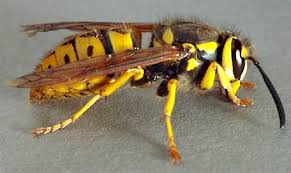
These are the wasps that cause the most sting injuries. They are able to sting repeatedly and will most often be around when there are a variety of meats and sweets available to them. This food is fed to their young. They can nest in the ground or above the ground in paper nests.
2) Bald Faced Hornet

These are black hornets that have white markings on the head (like the one in the picture) or at the base by the stinger. These hornets can be extremely aggressive. They build huge paper nests where they rear their young and the female hornets will fly outside the nest and sting repeatedly when attacked. There are around 400 wasps inside each fully formed nest.
3) Organ Pipe Mud Dauber Wasp


These wasps are among the "best" type to have around. The males will stay inside the mud tube that they've build to live in. The females will go around collecting spiders. These wasps will never sting unless they are squeezed, at which point they sting only in self defense. They keep spider populations down.
Hope you enjoyed! :)
Just like last time, if there is a wasp/hornet you would like more information on, leave a comment and I'll do a whole post dedicated to them!
1) Yellow Jackets
These are the wasps that cause the most sting injuries. They are able to sting repeatedly and will most often be around when there are a variety of meats and sweets available to them. This food is fed to their young. They can nest in the ground or above the ground in paper nests.
2) Bald Faced Hornet
These are black hornets that have white markings on the head (like the one in the picture) or at the base by the stinger. These hornets can be extremely aggressive. They build huge paper nests where they rear their young and the female hornets will fly outside the nest and sting repeatedly when attacked. There are around 400 wasps inside each fully formed nest.
3) Organ Pipe Mud Dauber Wasp
These wasps are among the "best" type to have around. The males will stay inside the mud tube that they've build to live in. The females will go around collecting spiders. These wasps will never sting unless they are squeezed, at which point they sting only in self defense. They keep spider populations down.
Hope you enjoyed! :)
Thursday, August 1, 2013
Wow...
....It's really hard to keep up with blog posts during the summer! Who knew?! I feel like no one told me that and it's upsetting. Summer is supposed to be the time that I can write a whole ton of blog posts on all the annoying pests that show up... Not my time to work and do other exciting things. Weird.
Anyway, lets do a post on bees shall we? We'll look at a few different kinds of bees and do some quick info on them. Make sure you comment here or on the facebook page to let me know if there's a specific bee you want more information on!
1) Bumble Bee

Bumble bees are very social and they collect pollen and nectar in order to feed their young. Queen and worker bees can sting and they will sting if provoked. These bees can sting you repeatedly!
2) Carpenter Bee

Carpenter bees look like bumble bees but the most major difference is that the yellow on their body is ONLY by the head, not lower by the stinger and in bands. They build burrows in dead wood. These bees are solitary and contrary to popular belief, they do not eat the wood, just move it to the side so they have a place to live.
3) Sweat Bees

Sweat bees are those tiny little annoying bees that buzz around you and don't seem to do much but annoy you. They are usually a 1/4 to 1/2 inch long and are black, brown, red, or metallic green. They are attracted to the salt in human sweat and will sting if squished against your skin.
Next blog entry we'll look at wasps! Yay!
Anyway, lets do a post on bees shall we? We'll look at a few different kinds of bees and do some quick info on them. Make sure you comment here or on the facebook page to let me know if there's a specific bee you want more information on!
1) Bumble Bee
Bumble bees are very social and they collect pollen and nectar in order to feed their young. Queen and worker bees can sting and they will sting if provoked. These bees can sting you repeatedly!
2) Carpenter Bee
Carpenter bees look like bumble bees but the most major difference is that the yellow on their body is ONLY by the head, not lower by the stinger and in bands. They build burrows in dead wood. These bees are solitary and contrary to popular belief, they do not eat the wood, just move it to the side so they have a place to live.
3) Sweat Bees
Sweat bees are those tiny little annoying bees that buzz around you and don't seem to do much but annoy you. They are usually a 1/4 to 1/2 inch long and are black, brown, red, or metallic green. They are attracted to the salt in human sweat and will sting if squished against your skin.
Next blog entry we'll look at wasps! Yay!
Monday, June 24, 2013
Oh New Jersey...
....aren't we the lucky ones?!
Just when you thought you were home free of the dreaded cicadas, there's a new bug in town! What is it you ask? Will it make loud noises at dusk? Will there be strange recipes for us to use it in? Will we find them all dead on the ground in piles?!
Who knows!
What we do know is that the Asian Mosquito is moving on in!
This mosquito is really quite bothersome. It lives in New Jersey (as well as many, many, MANY other locations) and is known to carry quite a few diseases including West Nile and Yellow Fever. This mosquito is very different in appearance compared to others: it is black with white patterns on the body. The most major difference between these mosquitoes and others is that they will attack at any time of day, not just at night like most other mosquitoes.
So how about we talk about where these insects hang out? The females will lay eggs near (not next) to stagnant water. This means that if your neighbors have a pool and the house is empty, thus creating stagnant water in the pool... be on the look out! Any man made ponds that don't have any kind of movement.... Definitely a danger zone!
If you think you have a mosquito problem and are noticing some issues, please make sure you contact your local pest control business right away (that's All-Way Pest Control if you're in New Jersey)! You could have a problem that leads to severe health issues! Also, please support small, local businesses... They are the bread and butter of where ever you live!
And some humor for your viewing pleasure.... Comic!
Friday, May 31, 2013
Weird but True: Cicadas!
Yay for my first weird but true post! This is going to focus on cicadas because, well, there is plenty of stuff out there that makes you stop and go "Wait.... Really?" And this blog is here to show that yes! It is true!
First up: The man who made music to the sound of cicadas. His name is David Rothenberg. Here is his wikipedia page. Followed closely with his personal website which you can find right here! Now for a quick overview. David graduated from Harvard and Boston and now teaches Philosophy and Music at NJIT! He is a jazz musician and apparently loves putting bug sounds to music. Now for what you really want to hear:
Click me now! Click me RIGHT NOW!
Next up: Are you into cooking? Do you enjoy trying out fancy new dishes? Does your taste palette need expanding? Well I have the recipes for you!
Yummmmmmmmmy!
Yummy! How about some cicadas in your soup? A lovely cicada sandwich perhaps? Or if you only like chocolate, a decadent cicada peanut butter cup?
And for those of you who are unsure about this whole process and who are grossed out by them:
Thursday, May 16, 2013
Cicadas
It's been a good long time don't you think? Life certainly does get in the way.... but no worries! I'm back and we're going to spend this blog talking about cicadas!
Did you know that this is the year of the 17 year cicadas? If you didn't, I will explain:
Cicadas only show up every 17 years. 17 years ago, the cicadas emerged from the ground in this area. They swarmed with all the males wanting to find a female partner (it always seems to be for that reason huh?). They find a mate, do their thing, and then promptly die. The females then lay their eggs in the trees where they hatch and then go into the ground where they hang out there for another 17 years.... Only for the cycle to start all over again. Sounds like fun right?
Not so much.
Cicadas are quite the nuisance. They are loud and when they die, they are all over everything. Not only that, but we're not talking about a few buzzing around the yard. We're talking about hundreds of these bugs. These bugs can be so loud when in a group, they can reach 100 decibels.
For more information on the 17 year cicadas, click here: http://www.foxnews.com/science/2013/05/16/cicadas-east-coast-march/
To see a video with a cicadas as the star and to hear the noise you'll hear (keep in mind this is ONE) click here: http://www.youtube.com/watch?v=mah26og11ms
More soon! :)
Thursday, April 18, 2013
Carpenter Ants, 2.0
Alright, here comes our second post on carpenter ants. Everyone, stop what you're doing and listen up! Carpenter ants are a big deal!
First of all, carpenter ants swarm in the spring. This is because this is when they are mating and looking for a new place to live. When the queen ant (who is winged) lands in a place they want to nest, they almost immediately lose their wings and start to burrow (NOT EAT!) the wood they are going to be living in.
Carpenter ants are most active at night (as with most insects) and can be found anywhere in your house that has damp or weak wood. Sometimes when you spot ants you are able to follow them to their nest in the house, therefore making it easier to eliminate the problem.
It is important to note that carpenter ants are JUST AS DANGEROUS TO STRUCTURES as termites. Although carpenter ants don't eat the wood, they do destroy the wood. Here is an example of what carpenter ants do to wood:

In order to help control carpenter ants and make sure that they do not come in to your home, you can take a few precautions. Make sure that trees and other plants are not touching your home as the ants can use a tree they are living in as a bridge to your house. Also, make sure that you take care of any leaks within your house immediately as carpenter ants LOVE wet wood. Also, make sure that if you're storing firewood during the summer it is AWAY from the house and off the ground. Carpenter ants LOVE firewood.
As always, please call your local pest control company if you have or suspect you have a problem. If you live in New Jersey give All-Way Pest Control, Inc a call!! :)
First of all, carpenter ants swarm in the spring. This is because this is when they are mating and looking for a new place to live. When the queen ant (who is winged) lands in a place they want to nest, they almost immediately lose their wings and start to burrow (NOT EAT!) the wood they are going to be living in.
Carpenter ants are most active at night (as with most insects) and can be found anywhere in your house that has damp or weak wood. Sometimes when you spot ants you are able to follow them to their nest in the house, therefore making it easier to eliminate the problem.
It is important to note that carpenter ants are JUST AS DANGEROUS TO STRUCTURES as termites. Although carpenter ants don't eat the wood, they do destroy the wood. Here is an example of what carpenter ants do to wood:
In order to help control carpenter ants and make sure that they do not come in to your home, you can take a few precautions. Make sure that trees and other plants are not touching your home as the ants can use a tree they are living in as a bridge to your house. Also, make sure that you take care of any leaks within your house immediately as carpenter ants LOVE wet wood. Also, make sure that if you're storing firewood during the summer it is AWAY from the house and off the ground. Carpenter ants LOVE firewood.
As always, please call your local pest control company if you have or suspect you have a problem. If you live in New Jersey give All-Way Pest Control, Inc a call!! :)
Subscribe to:
Posts (Atom)